Analyzing Swing Mechanics Parallels Between Professional Golf Drives and Baseball Home Runs in Optimal Launch Conditions
Avery Schulz · Jul 20, 2026
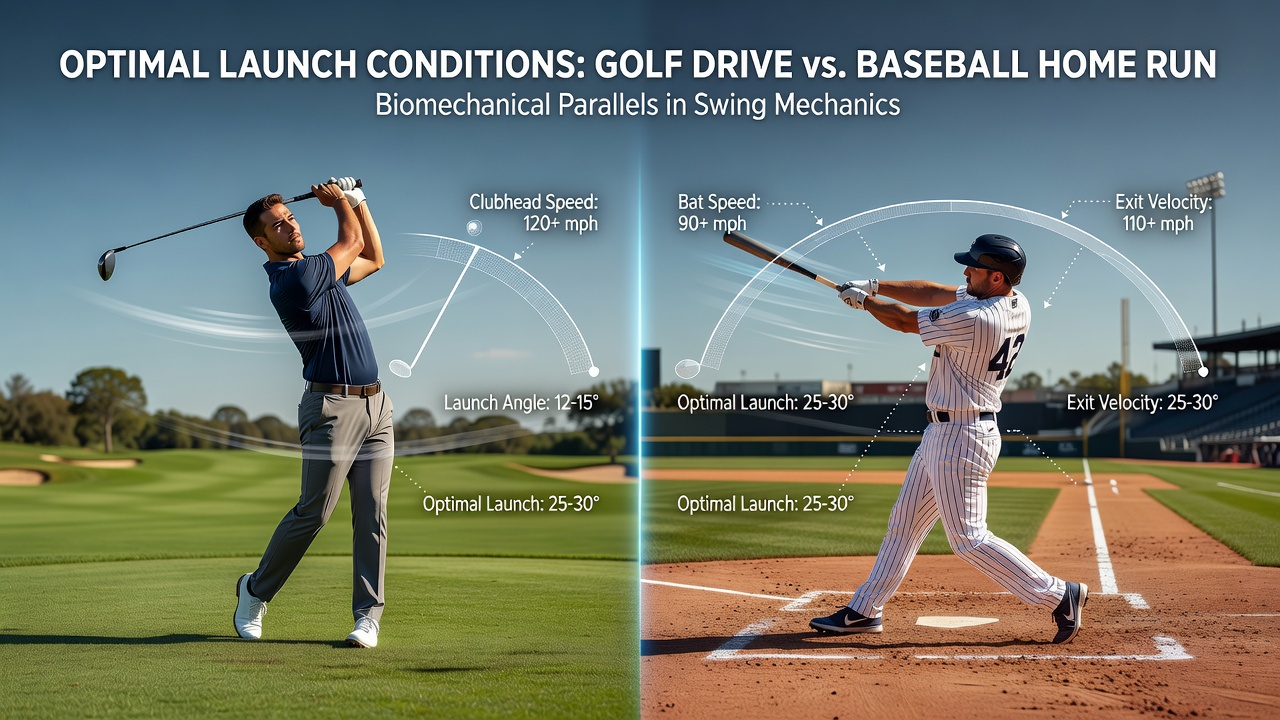
Analyzing Swing Mechanics Parallels Between Professional Golf Drives and Baseball Home Runs in Optimal Launch Conditions
Professional athletes in golf and baseball rely on precise swing mechanics to achieve optimal launch conditions, where ball speed, launch angle, and spin rate combine to maximize distance. Researchers have documented striking similarities in the kinetic chain from ground up through the torso and arms, even though the sports differ in equipment and objectives. Data from motion capture systems reveal that both motions generate power through sequential rotation of the pelvis, torso, and shoulders, with peak angular velocities occurring in similar patterns during the downswing phase.
Shared Kinematic Sequences in Power Generation
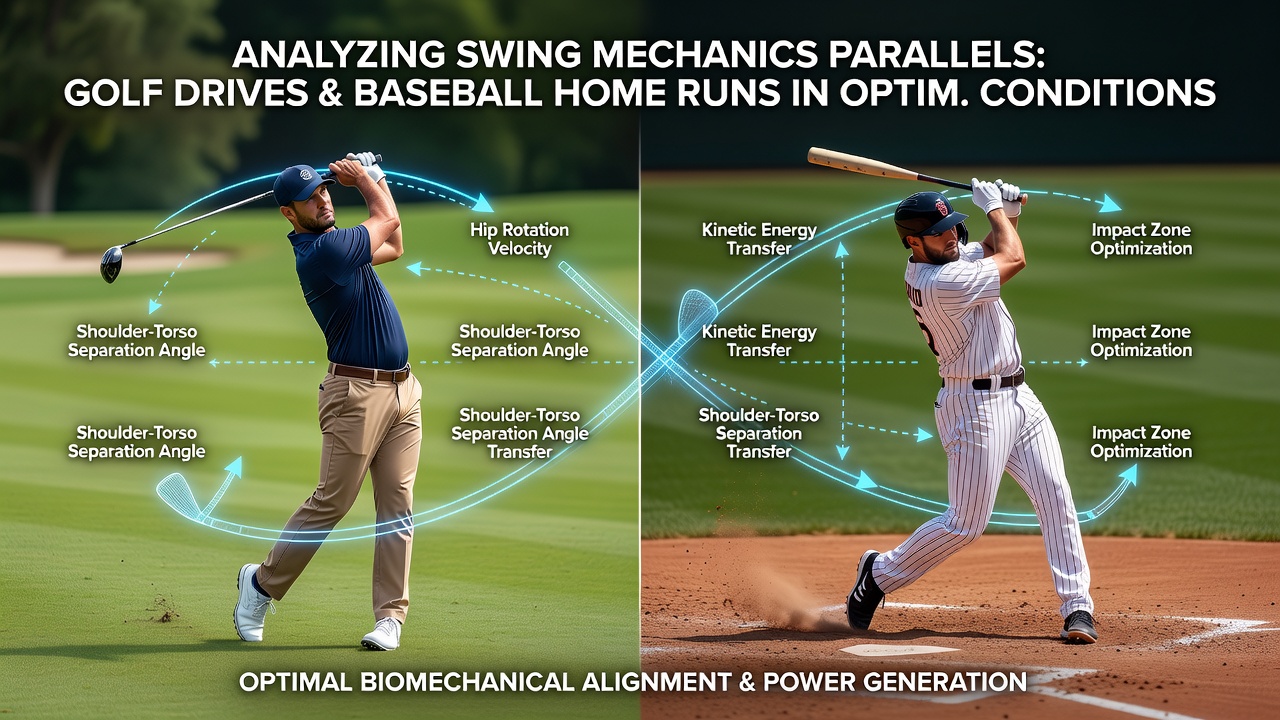
Studies of elite performers show that hip rotation initiates the swing in both disciplines, followed by trunk unwinding that transfers energy to the arms and club or bat. In golf drives, professionals achieve pelvis rotation speeds exceeding 700 degrees per second, while baseball hitters reach comparable rates during home run swings according to biomechanical analyses. The timing of shoulder rotation relative to hip clearance remains consistent across both, creating a whip-like effect that multiplies clubhead or bat speed at impact. Observers note that this proximal-to-distal sequencing allows athletes to store and release elastic energy in the core musculature, a pattern documented in multiple high-speed video studies conducted through 2025 and into mid-2026.
Launch Condition Targets and Measurement Tools
Optimal launch conditions differ by sport yet share underlying physics principles. Golfers target launch angles around 12 to 16 degrees with spin rates near 2500 rpm for maximum carry, whereas baseball players aim for 25 to 35 degrees with backspin between 2000 and 3000 rpm to clear outfield fences. Launch monitors such as TrackMan and FlightScope capture these metrics in real time for golfers, while Statcast and Rapsodo systems provide equivalent data for MLB players. Figures from combined datasets indicate that players who maintain attack angles within 2 degrees of their sport-specific optimum increase distance outcomes by measurable margins, with correlations holding steady across seasons ending in July 2026.
Ground Reaction Forces and Stability Factors
Force plate research highlights how both swings depend on vertical and horizontal ground reaction forces generated during the transition from backswing to downswing. Golfers shift weight onto the lead foot to create a stable base, producing peak vertical forces near 1.5 times body weight. Baseball hitters exhibit similar lead-leg bracing that channels rotational torque into the ball. Those who've examined synchronized EMG and force data find that core and glute activation timing aligns closely between the two motions when launch conditions are optimized. Equipment variations, such as golf cleats versus baseball spikes, influence traction yet do not alter the fundamental force application sequence observed in controlled lab settings.
Training Adaptations and Cross-Sport Applications
Strength and conditioning programs increasingly incorporate drills that emphasize rotational power and timing common to both movements. Medicine ball throws and cable wood chops appear in regimens for PGA Tour players and MLB hitters alike, targeting the same oblique and latissimus chains. Data from performance centers show that athletes who train these shared elements improve launch consistency, with carry distance gains reported in longitudinal tracking through 2026. What's interesting is how video overlay techniques allow coaches to compare swing planes side by side, revealing micro-adjustments in wrist hinge and forearm rotation that fine-tune spin axis for each sport's target conditions.
Environmental and Equipment Influences on Launch
Altitude, temperature, and humidity modify air density and therefore optimal launch parameters for both golf balls and baseballs. At higher elevations, reduced drag permits slightly lower launch angles while maintaining distance, a factor tracked in venues such as Coors Field and certain mountain golf courses. Ball construction differences, including dimple patterns in golf versus seam orientation in baseball, interact with spin rates to produce predictable flight paths under these variables. Research indicates that professionals adjust attack angles by fractions of a degree when moving between sea-level and elevated sites, preserving efficient energy transfer from swing mechanics to ball flight.
Conclusion
Biomechanical parallels between professional golf drives and baseball home runs emerge most clearly when examining the coordinated sequence of rotation, force application, and launch optimization. Measurement technologies continue to quantify these overlaps, providing athletes and coaches with actionable metrics that transcend individual sport boundaries. Continued data collection through 2026 and beyond supports refined training approaches that leverage these common foundations for performance gains.