Global Performance Trends in Endurance Demands Across Racket Sports, Contact Disciplines, and Team Field Games Since the 1990s
Avery Schulz · Jun 24, 2026
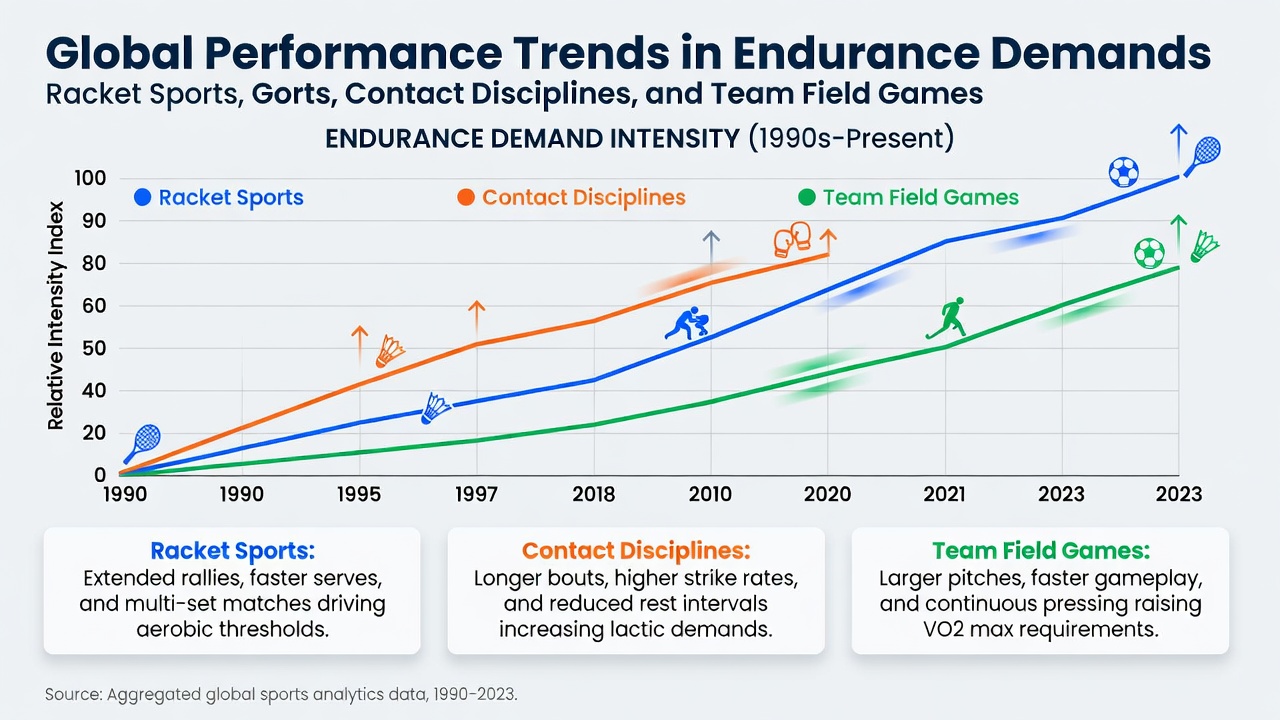
Global Performance Trends in Endurance Demands Across Racket Sports, Contact Disciplines, and Team Field Games Since the 1990s
Endurance demands in racket sports, contact disciplines, and team field games have shifted markedly since the 1990s, driven by rule modifications, advances in sports science, and changes in match scheduling that extend physical output across longer durations. Researchers tracking these patterns note that players in tennis and badminton now cover greater total distances per match while maintaining higher intensities for extended periods, whereas boxers and mixed martial artists sustain elevated heart rates through additional rounds or extended fight times. In team field games such as soccer and rugby, high-intensity running distances have risen steadily, with data indicating that midfielders and forwards execute more repeated sprints within each contest.
Shifts in Racket Sports Endurance Profiles
Since the introduction of tiebreaks in more sets and the expansion of best-of-five formats in major tournaments during the late 1990s, tennis professionals have adapted to matches that frequently exceed three hours. Studies compiled by the International Tennis Federation reveal that average rally lengths increased from approximately 4.5 shots in the early 1990s to over 6 shots by the mid-2010s, requiring athletes to recover repeatedly between points while covering side-to-side distances that accumulate beyond 3 kilometers in a single encounter. Badminton players experienced parallel changes after alterations to scoring systems in 2006, which produced longer rallies and forced competitors to maintain aerobic capacity throughout matches that now last 45 to 60 minutes on average.
Observers tracking elite circuits report that players from Europe, Asia, and the Americas exhibit similar upward trends in oxygen uptake thresholds, with training protocols emphasizing repeated sprint ability to match the evolving pace. Data collected through wearable technology shows heart rate zones remaining in the 85 to 95 percent range for greater percentages of match time compared with earlier decades, reflecting both faster ball speeds and denser schedules that compress recovery windows between rounds.
Adaptations in Contact Disciplines
Contact sports such as boxing and mixed martial arts adjusted their structures in ways that elevated endurance requirements starting in the 1990s. Boxing title bouts retained the 12-round limit yet incorporated shorter rest intervals and higher punch volumes, prompting fighters to develop greater lactate tolerance. Research published by Canadian sports institutes indicates that elite boxers now maintain punch output rates 15 to 20 percent higher in later rounds than counterparts from the 1990s, supported by improved cardiovascular conditioning and nutritional strategies.
Mixed martial arts, which gained structured global promotion in the late 1990s, introduced five-round championship fights that demand sustained grappling and striking endurance across 25 minutes of continuous effort. Athletes competing under these rules display elevated VO2 max values, with figures from Australian Institute of Sport analyses confirming that competitors sustain power output through multiple high-intensity exchanges without significant drop-off. Training methodologies evolved to incorporate interval sessions that replicate fight pacing, producing measurable gains in recovery speed between bursts of activity.
Team Field Games and Rising Work Rates
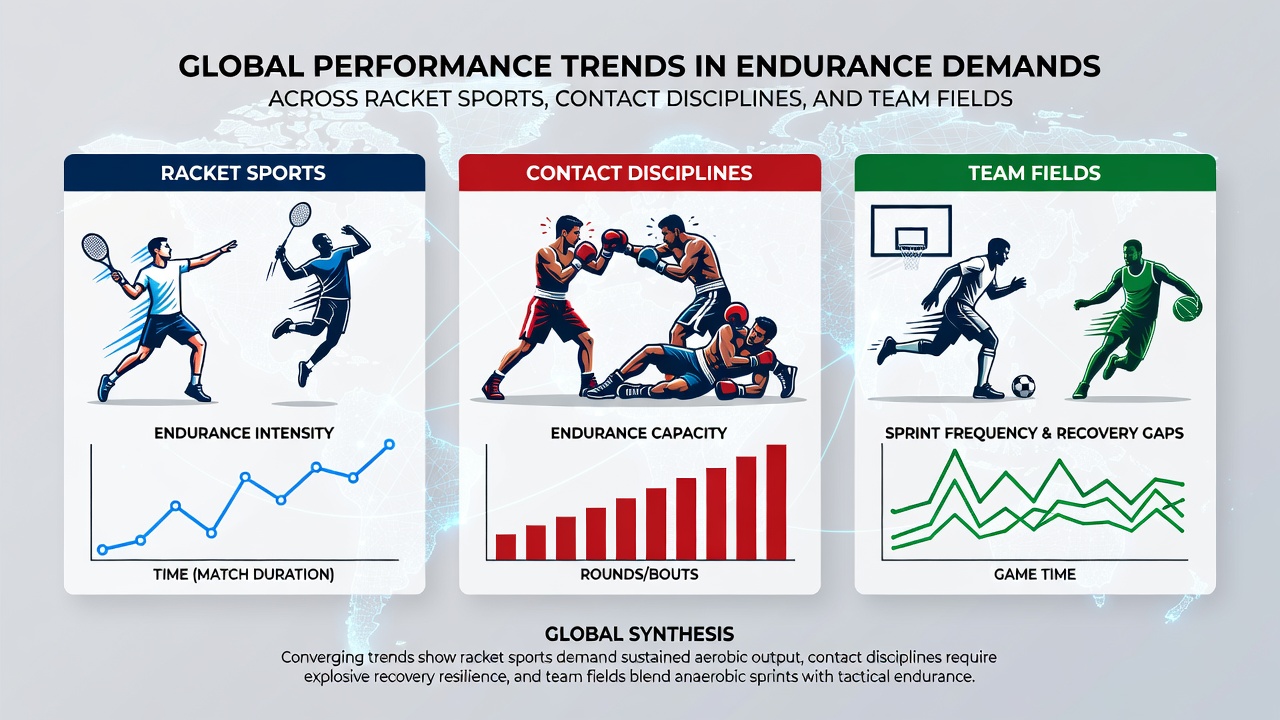
Team field games underwent perhaps the most documented increases in endurance load. Soccer matches tracked by UEFA and FIFA data sources show that total distance covered by players rose from roughly 8 to 10 kilometers in the 1990s to 10 to 12 kilometers by the 2020s, accompanied by a doubling of high-speed running segments. Midfielders in top European leagues now perform 30 to 40 percent more accelerations per game, a pattern mirrored in Australian A-League and South American competitions where similar tracking technologies confirm the trend. Rugby union and league codes introduced law changes in the early 2000s that reduced stoppages and increased ball-in-play time, resulting in forwards covering additional meters at moderate to high intensities.
Analyses from June 2026 reports issued by regional sports science bodies highlight that field hockey and lacrosse athletes likewise exhibit greater cumulative workloads, with GPS data indicating repeated efforts at speeds above 20 kilometers per hour occurring more frequently than in prior decades. These shifts coincide with year-round training calendars that emphasize aerobic base building alongside sport-specific drills, allowing athletes to tolerate denser fixture lists without performance decline.
Cross-Disciplinary Data Patterns
Comparative studies across continents demonstrate consistent directional changes despite differences in rules and cultures. European soccer leagues, North American combat sports promotions, and Asian racket sport circuits all register higher average work-to-rest ratios since the 1990s. Physiological testing conducted at multiple universities shows that athletes across these categories sustain blood lactate levels at higher thresholds for longer durations, supported by periodized programs that integrate strength, mobility, and recovery modalities developed over the past three decades.
Global federations continue to monitor these metrics through standardized testing batteries, producing datasets that allow direct comparison of endurance markers from one era to the next. The patterns indicate that preparation methods refined since the 1990s enable competitors to meet the amplified physical requirements while reducing certain injury risks associated with fatigue accumulation.
Conclusion
Performance data collected since the 1990s illustrate that endurance demands have intensified across racket sports, contact disciplines, and team field games through a combination of structural rule adjustments, technological monitoring, and evidence-based training. Athletes now operate under conditions that require greater total energy expenditure and faster recovery capacities, trends documented consistently in research outputs from multiple geographic regions. These developments continue to shape preparation strategies and competition formats into 2026 and beyond.