How Youth Development Pipelines Have Shifted Talent Distribution Among International Soccer Leagues and Domestic Baseball Organizations
Avery Schulz · Jul 6, 2026
How Youth Development Pipelines Have Shifted Talent Distribution Among International Soccer Leagues and Domestic Baseball Organizations
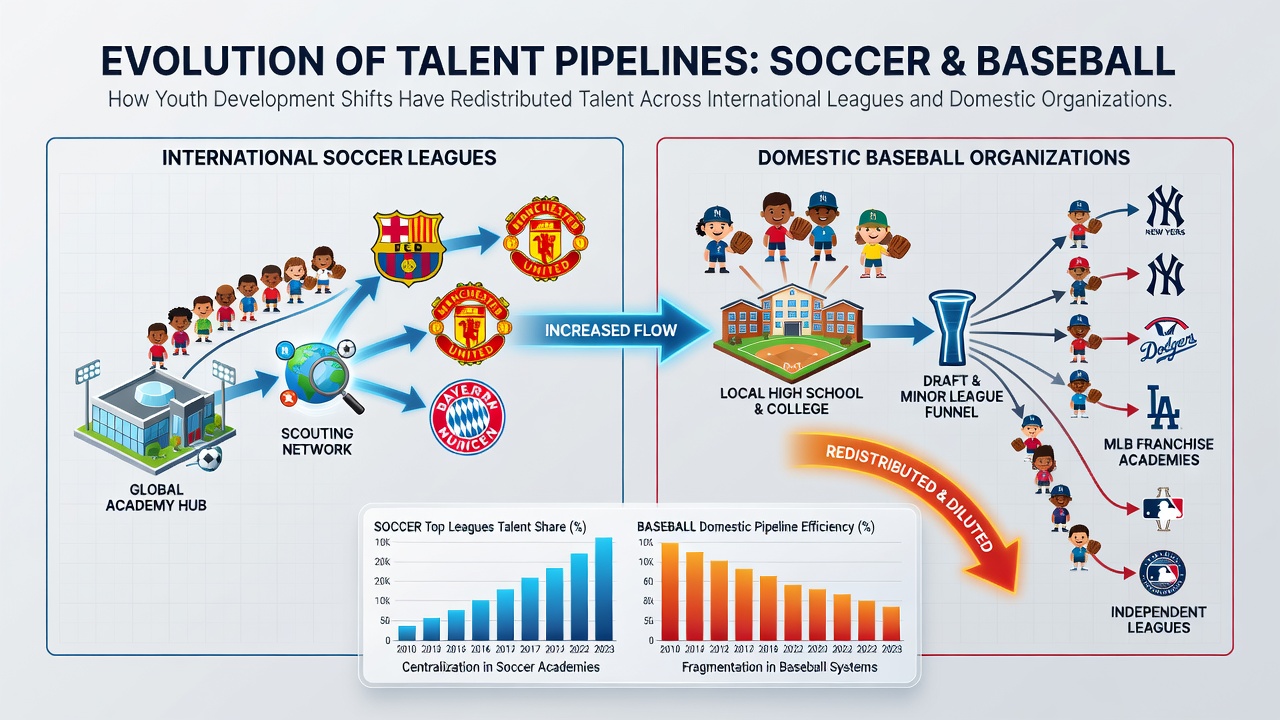
Youth development pipelines in soccer and baseball have undergone measurable changes over the past two decades, and data from league tracking systems shows altered patterns in where elite talent emerges and where it ultimately competes. International soccer leagues now draw from expanded global scouting networks that begin in early adolescence, while domestic baseball organizations maintain structured systems centered on regional academies and draft mechanisms that funnel players toward major league rosters.
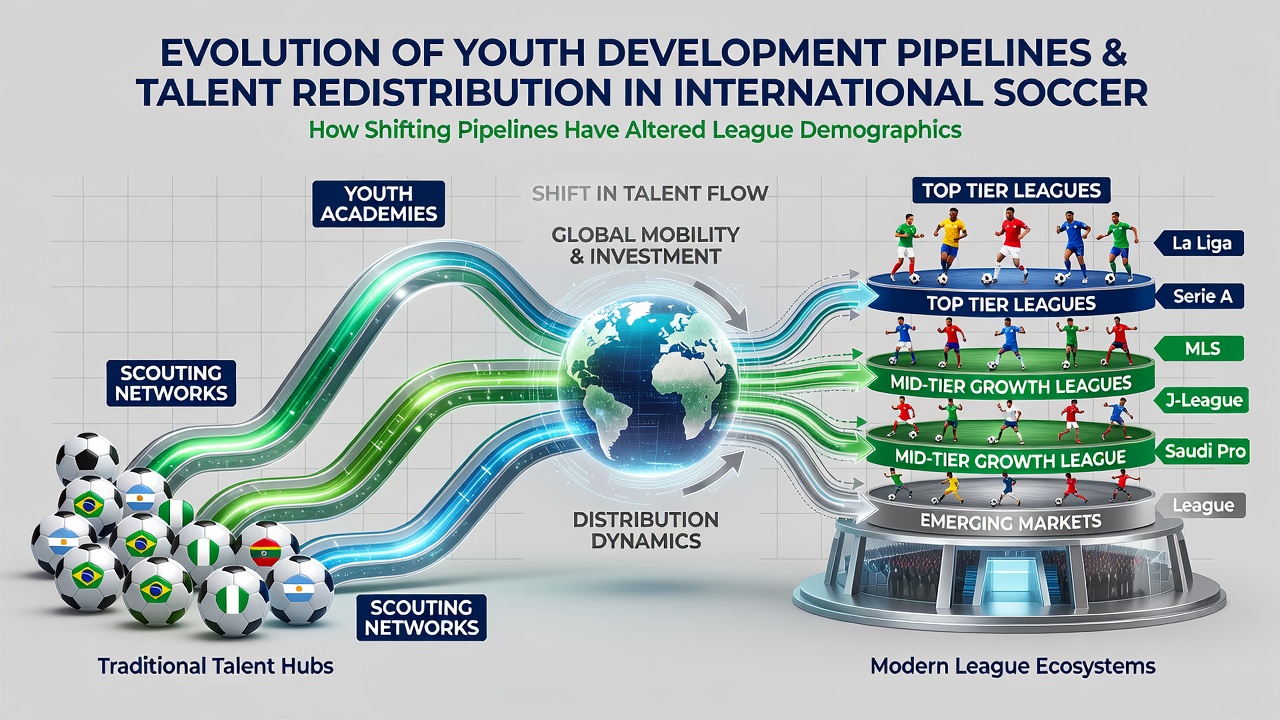
European soccer clubs operate extensive academy programs that identify prospects as young as age nine or ten, and these pathways frequently route talent from South America, Africa, and Asia into top divisions. Figures from UEFA club licensing reports indicate that the proportion of non-European players in academies across the five major leagues rose from roughly 18 percent in 2010 to over 34 percent by the 2025 season. This shift coincides with investments in satellite facilities in Brazil, Nigeria, and Japan, where clubs maintain direct oversight of training protocols and educational support.
Expansion of Soccer Academy Networks
Clubs such as FC Barcelona, Ajax Amsterdam, and Manchester City have scaled their youth operations through partnerships that allow early relocation of selected players, and these arrangements often include visa sponsorships tied to athletic scholarships. Observers note that the Bosman ruling and subsequent transfer regulations enabled freer movement once players reached age 18, which accelerated the flow of academy graduates into first-team environments across borders. In July 2026, FIFA's updated youth player registration database recorded more than 12,000 international transfers involving under-21 athletes in the preceding 12 months, a volume nearly double the level documented in 2015.
Domestic baseball pipelines operate differently because Major League Baseball maintains a centralized draft system for United States and Canadian amateurs alongside annual international signing periods focused primarily on Latin American countries. Academies in the Dominican Republic and Venezuela function as primary entry points, and organizations like the New York Yankees and Los Angeles Dodgers operate year-round facilities that combine baseball instruction with academic tutoring. MLB's annual international signing period data reveals that approximately 65 percent of foreign-born players on 2026 opening-day rosters entered through these academies rather than through the draft.
Baseball's Regional Focus and Structural Differences
Baseball's talent distribution has remained more regionally concentrated than soccer's, yet incremental changes appear in the nationalities represented on minor league rosters. Research compiled by the Society for American Baseball Research shows a gradual increase in players from Australia, South Korea, and Taiwan since 2018, driven by expanded scouting budgets and showcase tournaments held in those countries. Meanwhile, the traditional Dominican pipeline continues to supply the largest share of international signees, accounting for 48 percent of all foreign contracts awarded between 2020 and 2025.
Comparisons between the two sports highlight contrasting regulatory environments that shape pipeline outcomes. Soccer's FIFA-mandated rules on minor transfers impose strict documentation requirements and compensation formulas for training clubs, whereas baseball's international signing bonus pools create annual spending caps that limit how many high-profile prospects any single organization can secure. These constraints produce measurable effects on roster composition, with soccer clubs more likely to integrate multiple nationalities within a single academy cohort and baseball teams tending to cluster players from specific geographic zones.
Measurable Impacts on League Rosters
League-wide statistics illustrate the downstream consequences of these pipeline shifts. In the English Premier League, the percentage of players who entered professional environments through non-UK academies reached 41 percent during the 2025-26 season according to Premier League player registration records. In contrast, MLB teams report that roughly 28 percent of active roster spots belong to players developed outside the United States and Canada, a figure that has held relatively steady since 2017 despite increases in total international signings.
Additional data points emerge when examining second-tier leagues. Spain's Segunda División and Italy's Serie B have absorbed increasing numbers of academy graduates released by larger clubs, creating intermediate steps that allow continued development before potential moves abroad. Baseball's Triple-A and Double-A affiliates similarly serve as proving grounds, and tracking by Baseball America shows that 72 percent of players who reach MLB debut spend at least two full seasons in affiliated minor league systems regardless of their entry route.
Cross-Sport Observations on Retention and Mobility
Retention patterns also differ. Soccer players who leave their initial academy before age 16 face higher rates of movement across borders, while baseball prospects signed at 16 or 17 typically remain under one organization's control through the minor league system for several years. These structural distinctions influence how talent distributes across competitive levels and how quickly players from emerging markets appear in top divisions.
Organizations continue to refine scouting technologies and training methodologies, and both sports have incorporated data analytics into youth identification processes. GPS tracking, video analysis, and biomechanical assessments now inform decisions that once relied primarily on live observation, though the fundamental geographic sources of talent have not undergone wholesale replacement. Instead, the pipelines have widened and diversified while preserving core regional strengths established over prior decades.
Conclusion
The evolution of youth development structures in soccer and baseball reflects adaptations to regulatory frameworks, economic incentives, and global scouting capabilities rather than abrupt transformations. Continued monitoring of transfer records, academy enrollment figures, and roster demographics will clarify whether current trajectories persist or whether new regions gain prominence in supplying elite talent to the highest levels of each sport.