Seasonal Birth Patterns Among Elite Athletes in Individual Versus Team Sports
Avery Schulz · Jun 6, 2026
Seasonal Birth Patterns Among Elite Athletes in Individual Versus Team Sports
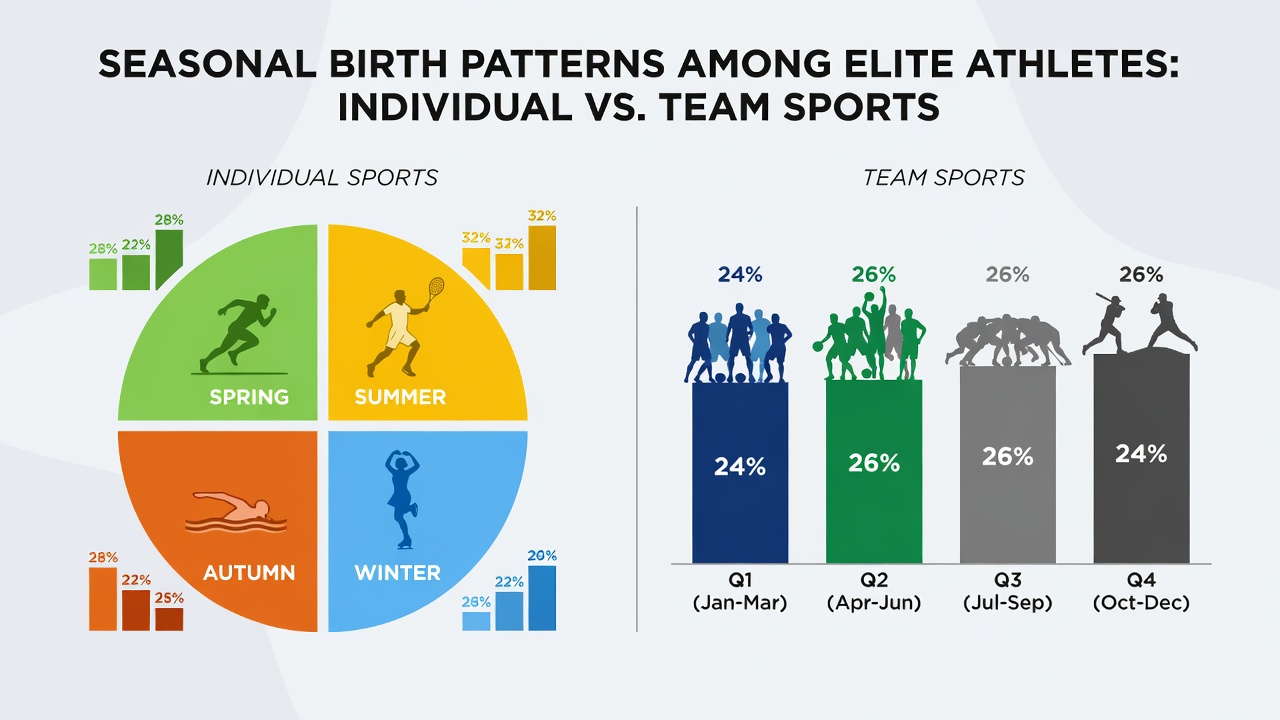
Seasonal birth patterns among elite athletes reveal consistent disparities tied to calendar cutoffs in youth categories, with researchers documenting overrepresentation of athletes born in the first quarter of the year across multiple disciplines. Data from professional leagues and Olympic rosters indicate that these distributions stem from relative age effects, where athletes born shortly after annual selection dates gain physical and developmental advantages during critical growth periods. Studies tracking birth months in high-level competitors show stronger clustering in team environments compared to individual pursuits, although both categories exhibit measurable imbalances.
Relative Age Effects in Team Sports Contexts
Team sports such as soccer, hockey, and basketball demonstrate pronounced seasonal skews, with analyses of European and North American professional rosters confirming that players born between January and March comprise up to 40 percent of squads in certain leagues. Canadian hockey data spanning several decades reveals that early-year births correlate with higher draft selections and extended careers, since those athletes enter age-group competitions with greater size and coordination at younger chronological stages. Similar patterns appear in Australian football leagues, where selection committees prioritize immediate performance metrics that favor the physically advanced. Observers note that team dynamics amplify these effects because coaches often field the most mature lineups to secure short-term results, creating self-reinforcing cycles that limit opportunities for later-born peers.
Longitudinal reviews of Premier League and NBA participants further illustrate how birth quarter influences longevity, with first-quarter athletes maintaining roster spots at higher rates through their twenties and thirties. European Union sports federations have compiled datasets showing parallel trends in handball and volleyball, where collective strategies reward early physical peaks. Yet adjustments like age-ordered groupings in some youth academies have begun to narrow gaps without eliminating the underlying distribution entirely.
Patterns Observed in Individual Sports
Individual sports present more varied seasonal distributions, although early-year births still appear frequently among top performers in tennis, swimming, and track events. Research compiled by institutions in Australia and Canada indicates that athletes in these fields experience relative age advantages primarily during junior rankings, where qualifying standards and seeding depend on age brackets. Golf and combat sports display subtler effects, since technical precision and personal pacing can offset initial size differences more effectively than in team settings.
International tennis federations report that grand slam participants born in the first half of the year hold slight majorities in elite draws, yet the margin narrows compared to team rosters because training regimens emphasize individualized progression rather than squad selection. Swimming governing bodies in the United States and Europe document comparable trends in Olympic trial qualifiers, where stroke efficiency and endurance training allow later-born competitors to close developmental gaps by late adolescence. Those who've examined medal distributions across multiple Games cycles find that individual sports permit greater compensation through specialized coaching and physiological monitoring, reducing the permanence of early selection biases.
Comparative Data Across Categories
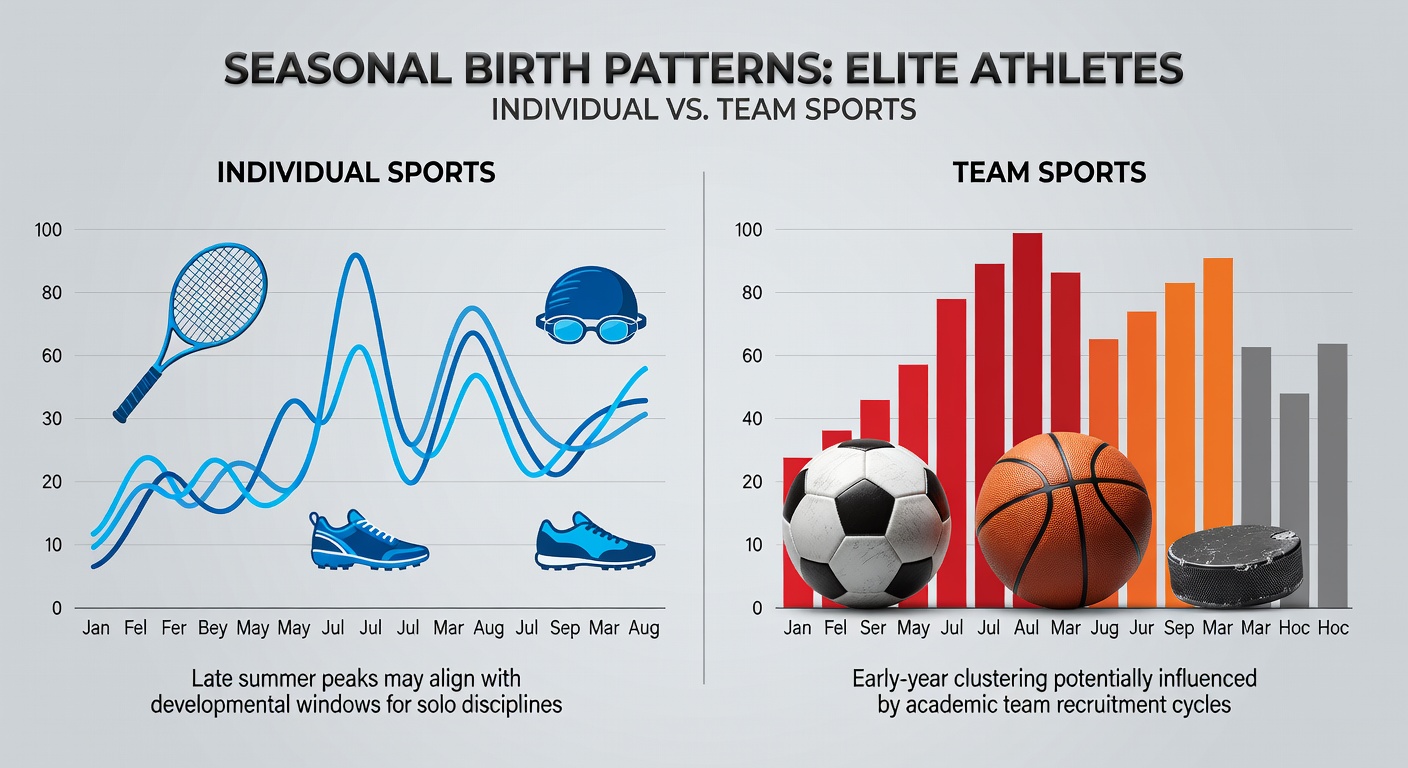
Direct comparisons between individual and team sports highlight how structural differences shape birth patterns, with team environments producing steeper gradients according to multiple peer-reviewed analyses. Figures from studies conducted through 2025 reveal that soccer and basketball leagues exhibit relative age effect sizes roughly double those measured in tennis or athletics cohorts. This divergence arises because team selection often hinges on immediate physical matchups during adolescence, whereas individual events reward accumulated skill refinement that benefits from extended development windows.
Researchers tracking career trajectories across continents note that team athletes born later in the year face higher attrition rates before reaching professional thresholds, while individual sport participants encounter more flexible pathways through national programs and private academies. Data aggregated by sports science centers in Canada and the European Union demonstrate that interventions such as bio-banding, which groups competitors by physical maturity rather than birth date, have produced measurable increases in retention for later-quarter athletes in both domains, although adoption remains uneven. What's interesting is how these adjustments interact with sport-specific demands, allowing team strategies to incorporate diverse age profiles while individual competitors leverage personal analytics for targeted gains.
Recent Trends and Monitoring Efforts
Monitoring initiatives launched in the mid-2020s continue to refine understanding of these patterns, incorporating advanced tracking from wearable devices and performance databases. By June 2026, updated rosters from major leagues show persistent yet slowly moderating imbalances, particularly in team sports where federations have introduced revised youth calendars. Academic repositories hosted by universities in Australia and the United Kingdom archive longitudinal datasets that link birth timing to injury profiles and peak performance windows, providing granular views of how seasonal factors intersect wth training loads.
International bodies overseeing Olympic preparation have integrated birth distribution reviews into talent identification protocols, emphasizing evidence-based adjustments over traditional cutoff reliance. These efforts draw from cross-regional comparisons that avoid single-nation biases and instead synthesize findings from North American, Asian, and Oceanic samples. The resulting frameworks support more equitable access without altering core competitive structures.
Conclusion
Seasonal birth patterns continue to influence athlete representation across elite levels, with team sports displaying more rigid early-year dominance than individual disciplines according to accumulated evidence. Ongoing data collection and structural adaptations demonstrate measurable shifts in participation rates, underscoring the interplay between developmental biology and organizational practices. Further examination of these dynamics across expanding datasets promises additional clarity on pathways that balance immediate performance with long-term equity.